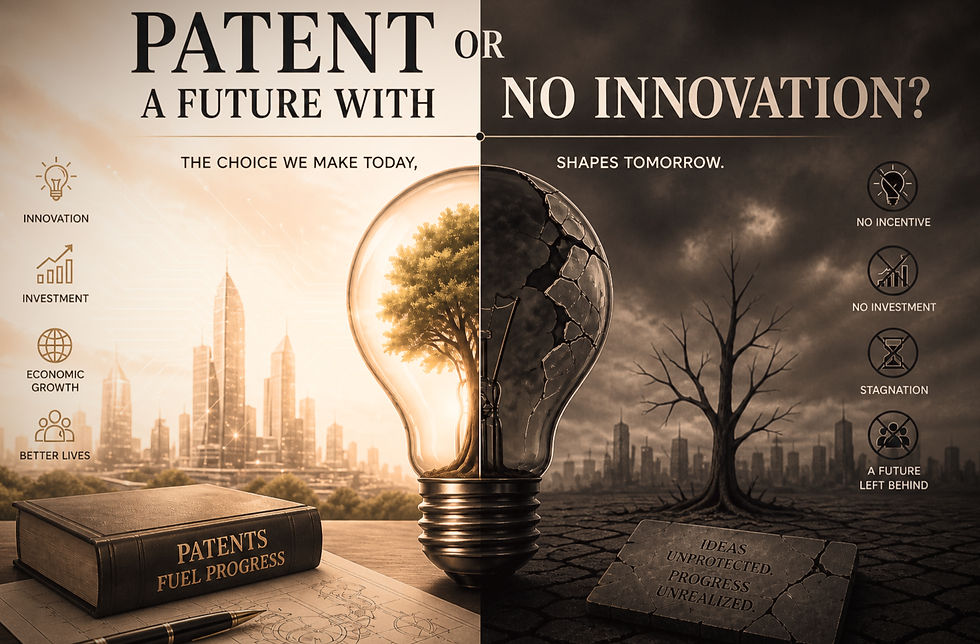
If we did not already have a patent system, we would have to invent it - or else face a future with no innovation?
Updated: May 6
[Law discussed as per UK Jurisdiction]
Introduction:
The patent system is designed to protect inventions by granting inventors exclusive rights over their creations, particularly in fields such as technology and medicine. Rather than offering a rigid definition of what an “invention” is, patent law identifies it through certain essential requirements—namely novelty, an inventive step, and industrial applicability. In this sense, an invention is not simply a new idea, but one that is technically grounded and meets the legal threshold for protection.
In the modern world with Artificial intelligence and new inventions being made it is important for the patent system to exist. Patent promotes the new inventions which leads to economic development by providing the incentive to broaden the inventions and come up with new technologies. The absence of a patent system in a country would lead to trade secrets and will not incentivize companies and inventors to put forth their inventions. If looked upon in the history of the development of the patent system, it will be visible that many countries in the beginning did feel threatened from enforcing the patent system in their countries. But gradually the need for a patent system was felt with the fact-paced inventions in the technology and medical systems. (1)
Research Questions:
Whether or not the patent system is essential for fostering inventions?
Whether or not the development in the patent system proved to be essential for innovations and economic growth?
Arguments in Favour of the Patent System
Patents have been noticed since the early 17th century and the concept that was laid down was that the state grants the patent on an invention which will be published out in public and in return the innovators would get a patent for their invention. As the duration of a patent is twenty years, it is providing the monopoly over the invention for a limited time. Therefore, it will be in the public domain for the other companies to use the invention and sell it in the market without paying for the patent.
Granting of a patent would also encourage and enable disclosure by the innovator instead of keeping it a trade secret. The patent system has become so strong in this modern world, it is because of the protection it provides and how it safeguards the hard work laid down in an invention. Along with the protection it also benefits innovators as they receive an exclusive right over the invention to be sold or licensed. (2)
All the advantages of the patent system proves how big of an incentive it is for the companies and inventors to invest more and get involved in this competitive environment of getting the patent before it becomes a prior art.
Arguments Against the Necessity of a Patent System
One of the most widely debated concerns among jurists is the issue of market monopoly. While competition law seeks to prevent monopolistic practices and ensure fair market conditions, the patent system, by its very nature, grants exclusive rights that can create monopolies in sectors such as pharmaceuticals and technology. Although patents are intended to protect inventors, they can also operate as barriers to entry, particularly for small and medium-sized enterprises (SMEs).
Historically, during the sixteenth and seventeenth centuries in the United Kingdom, patents granted under the Royal Prerogative were often criticised for being expensive and time-consuming to obtain. This concern persists even today, as the process of securing a patent continues to be both costly and procedurally complex.
As a result, companies with greater financial resources are more likely to obtain patent protection, while smaller innovators and independent researchers may be compelled to place their inventions in the public domain. This dynamic can lead to an uneven competitive landscape, where large corporations primarily compete among themselves, often limiting meaningful participation from smaller innovators. (3)
Analysis:
To understand the question why the patent system is important for the innovators, it is crucial to understand the history of development of the system. The origin of the patent system can be linked back to its origin in some Greek cities and it was granted for the first time in 1421 in Florence. After that the first English patent was granted by King Henry VI for a glass making process. At that point also it was argued that granting a patent had caused monopoly in the market because of which in the 16th century crown decided to revoke all the patents on the reasoning that they are “contrary to laws”. In the late 16th century England's first patent law was introduced but it still needed a reform as it was complicated and expensive.
By the 19th Century the patent law had evolved up to great extent as the Paris Convention in 1883 laid down the laws for international relations and patents. Before the Paris Convention the patents granted were for their country and patent holders had no protection in other countries. Therefore their rights were getting exploited. The convention had laid down the principle for internationalisation of the patent system which appeared to be the solution to the problem faced by many patent holders. In the past the Netherlands had abolished the patent system from 1869 up until 1912, it was because of the limited industrialization revolution. In 1910 the Dutch government accepted a patent application and in 1955 an act was enforced. In the European Union the European Patent Convention (EPC) was one of the finest steps by the EU which further on established the European Patent Office, which permitted patent holders to file applications for multiple member states. (4)
Therefore, the history of the development laid down above presents that even though the patent system has been criticised for beginning, it has also been chosen over by many governments to maintain a system.
The United Kingdom enforced its Patent Act in 1977 which had its link with EPC. The precedent Dranez Anstalt V. Hayek (5) had introduced the “Incentive theory” explaining the reason behind why the patents need to be granted. In the case of Biogen Inc V Medeva (6) Lord Hoffman had put more weight on the “reward by monopoly theory”. He made a point that the courts shall acknowledge the innovators contribution in the innovation while being cautious not to impede the research. This landmark judgement had also explained the obviousness for a person skilled in the art (PSA).
Another landmark judgement which embarks the history in the patent system is the Diamond case i.e., Diamond V. Chakrabarty (7), it was a judgement by the US Supreme Court on Gene patent. It had opened a door for the biotechnological patents by allowing the patents on the genes and it gave a path to genetic engineering.
The landmark judgments provided above proves how much the patent system has evolved till now and how successful it is. The battle on whether the Patent system is necessary is over now, it is over AI being patented. One of the most recent cases i.e., Thaler V Comptroller-General of patents, design and trademark (8) had an issue, whether an invention by AI can be patented. The SC ruled against the Appellant and ruled that the invention has to be by Human for it to be patented. (9)
Conclusion:
Therefore, the patent system has consistently demonstrated its role in fostering innovation and economic growth by granting exclusive rights that incentivise investment in research and development. International frameworks such as the TRIPS Agreement, the Paris Convention for the Protection of Industrial Property, and the European Patent Convention have further strengthened this system by harmonising protection across jurisdictions. The emerging debates surrounding artificial intelligence and patentability do not undermine the system; rather, they highlight its capacity to evolve in response to technological change. This continued adaptability underscores the enduring relevance of patent law in regulating innovation in an increasingly complex and digital world.
References :
Encaoua D, Guellec D, Martínez C. Patent systems for encouraging innovation: Lessons from economic analysis. Research Policy 2006;35:1423–40.
The Great IP Debate: Do patents do more harm than good? Science|Business July 28, 2016.
Economics Observatory. What can we learn about patents and innovation from the past? - Economics Observatory. Economics Observatory 2024.
Karapapa, S. & McDonagh, L. (2019) Intellectual Property Law. [Online]. Oxford University Press.
Dranez Anstalt V Hayek [2003] FSR 561
Biogen Inc V Medeva [1997] RPC 1
Diamond V. Chakrabarty 477 U.S 303 (1980)
Thaler V Comptroller-General of patents, design and trademark 2021/0201


Comments